Elevating Quality Management and Operational Resilience with Business
Redefining Global Standards in Quality Management
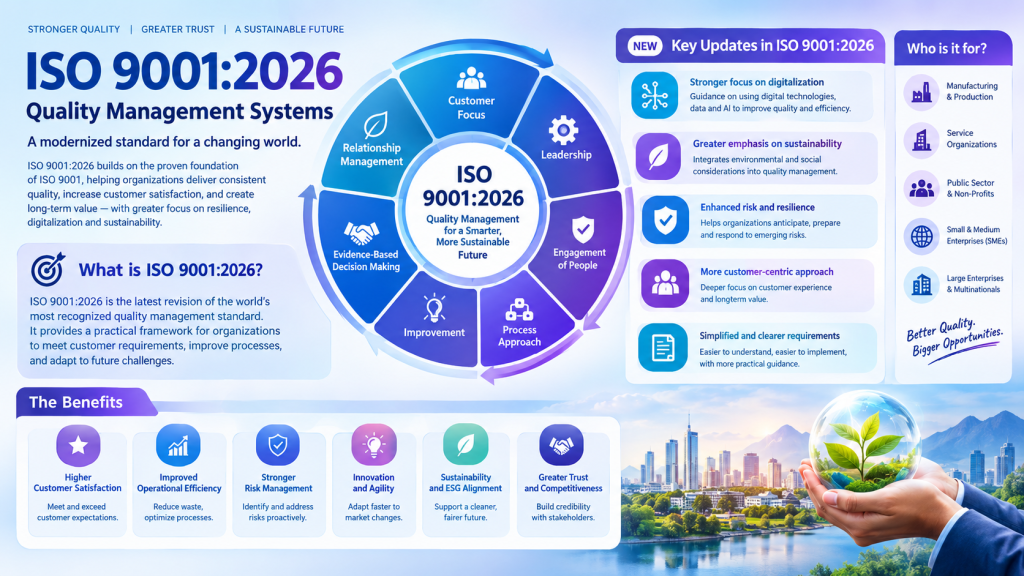
The International Organization for Standardization (ISO) has formally published the latest revision of the world’s most widely recognized Quality Management System (QMS) standard: ISO 9001:2026. Succeeding the ISO 9001:2015 edition, this major update modernizes quality management principles to address digital transformation, heightened supply chain volatility, and evolving customer expectations.
As an independent certification body proudly accredited by the Joint Accreditation System of Australia and New Zealand (JAS-ANZ), Business Systems Certification (BSC / BCert) is actively assisting clients across our international network to understand, plan, and achieve a smooth transition to the 2026 standard.
What Is New in ISO 9001:2026?
While preserving the core Plan-Do-Check-Act (PDCA) cycle and customer-centric process approach, ISO 9001:2026 incorporates key enhancements designed to make quality management more proactive and resilient:
- Systemic Risk & Disruption Management (Clause 6): Deepens risk-based thinking to encompass external disruptions, supply chain vulnerabilities, and operational agility.
- Digital Transformation & Emerging Technology: Recognizes the growing impact of automated processes, digital records, and technology-driven service delivery on product and service conformity.
- Enhanced Climate & Context Integration (Clause 4): Formally aligns organizational context with contemporary sustainability factors and external operating environments.
- Culture of Quality & Leadership Engagement (Clause 5): Emphasizes ethical conduct, organizational agility, and the active involvement of top management in driving continual improvement.
The 3-Year Transition Timeline
In line with International Accreditation Forum (IAF) policies, certified organizations have a three-year transition period from the official publication date to migrate their existing certifications:
| Milestone / Stage | Timing | Operational Impact for Clients |
| Publication & Rollout | 2026 | ISO 9001:2026 is officially enacted; organizations may begin gap reviews and system adjustments. |
| Transition Audits | 2027 – Early 2029 | BSC delivers transition audits, preferably alongside scheduled annual surveillance or triennial reassessment audits. |
| Transition Cut-Off | Mid-2029 | All existing ISO 9001:2015 certificates expire globally; certification must be held under ISO 9001:2026. |
Recommended Action Plan for Certified Organizations
- Benchmark Against the 2026 Standard: Perform an internal gap review to compare current organizational processes, risk registers, and documentation against the revised requirements.
- Develop Internal Competencies: Train internal auditors and process owners on the updated clauses, risk frameworks, and evidence-gathering techniques.
- Harmonize Changes Systematically: Update relevant operating procedures, performance indicators, and quality objectives.
- Coordinate with BSC: Plan your formal transition audit in advance to ensure optimal scheduling during your next surveillance or recertification visit.
The BSC Advantage: Value-Driven Transition Support
At Business Systems Certification, our audit methodology focuses directly on your operational needs and business context:
- Competent Sector Specialists: Our experienced auditors bring deep technical expertise across manufacturing, services, healthcare, and engineering sectors.
- Integrated Audit Efficiencies: Seamlessly combine your ISO 9001:2026 upgrade with your existing audits for ISO 14001 (Environmental) or ISO 45001 (Health & Safety) to minimize operational disruption and audit mandays.
- Independent & Impartial Oversight: Impartiality and technical rigor remain central to every certification decision we make.
To register for transition updates, request a gap assessment, or speak with our technical team, submit an inquiry or contact us at info@bscertification.com.